Most cleaning vendors sell on price and schedule. In a data center, cleanroom, or lab, those are the least important things about them. Here are the questions that actually separate a vendor who can work in a critical environment from one who will quietly damage it.
Do your own employees do the work, or do you subcontract it?
Ask this first. Subcontracting is the single most common reason critical-environment cleaning fails: the company you signed with is not the company standing in your white space at 2am, and the training you were promised was never delivered to the person holding the vacuum. Ask for a direct answer, and ask who employs the supervisor.
Direct Clean does not subcontract. Every technician on your site is our employee, screened and trained by us.
What happens to your protocol when my SOPs conflict with it?
The right answer is that your SOPs win. A vendor who leads with their own proprietary method in a validated environment is telling you they intend to work around your change-control process. In a classified space, that is a compliance problem before it is a cleaning problem.
What documentation will I get after each visit?
In a critical facility, undocumented cleaning is functionally the same as no cleaning — you cannot show an auditor a clean room, only a record. Ask what the per-visit record contains, who signs it, and how long it is retained. If the answer is a signature on a clipboard, that vendor has not worked in a regulated environment.
What equipment and materials do you bring into the space?
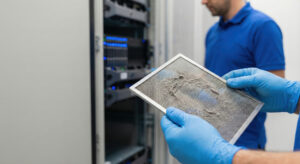
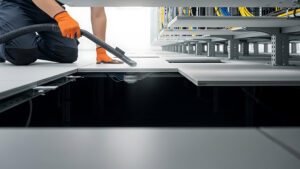
Cotton mops shed. Consumer disinfectants leave residue. Standard shop vacuums exhaust the particulate they just collected straight back into the room. Ask specifically about HEPA filtration, non-shedding and ISO-rated consumables, anti-static materials, and whether they will use your approved-materials list where you have one.
How do your technicians handle live equipment?
There should be a clear no-touch rule. In a data center that means exterior dust removal only — no opening cabinets, no contact with cabling, no liquids near energized equipment. A vendor who does not volunteer a boundary here has not thought about the failure mode.
Who is accountable when something goes wrong?
Ask for the escalation path by name and role. In a franchise model, the answer is often a territory owner with no authority over the crew and no relationship with you. Ask how many people sit between you and someone who can actually change how the work is done.
How do you handle security and access?
Background checks, badging, escort policy, and a stable roster rather than rotating labor. In a high-security facility, a vendor who cycles unfamiliar people through your access control is creating a risk that has nothing to do with cleanliness.
The short version
A vendor who can answer these seven questions without hedging has worked in environments like yours. One who cannot is quoting on square footage.
Direct Clean has cleaned critical and high-tech facilities across the Northeast since 1988, with our own employees and our founder still accountable for the work. See Data Center Cleaning, Cleanroom Cleaning, or Commercial Cleaning in New York City.
What is the most important question to ask a critical-facility cleaning vendor?
Whether they use their own employees or subcontract the work. Subcontracting is the most common reason critical-environment cleaning fails, because the company you contracted with is not the company performing the work and the promised training often never reaches the technician on site.
Should a cleaning vendor follow my SOPs or their own?
Yours. In a validated or classified environment your standard operating procedures govern, and a vendor leading with a proprietary method is signalling they intend to work around your change-control process.
What cleaning documentation should a critical facility require?
A per-visit record stating what was cleaned, when, by whom, and what conditions were found, retained long enough to satisfy audit and change-control review. In a regulated environment you cannot show an auditor a clean room, only a record.
Can cleaning technicians touch live equipment in a data center?
No. The rule should be exterior dust removal only — no opening cabinets, no contact with cabling, and no liquids near energized equipment. A vendor who does not volunteer that boundary has not considered the failure mode.